
Thanks to the work of NEI scientists and grantees, we’re constantly learning new information about the causes and treatment of vision disorders. Get the latest updates about their work — along with other news about NEI.
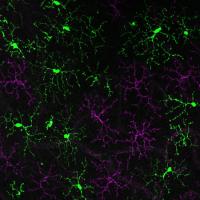
Researchers have successfully transplanted human microglia into mouse retina to create a model for studying eye disease treatments, such as diabetic retinopathy, glaucoma and age-related macular degeneration.
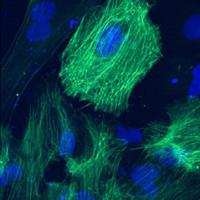
Researchers at NIH’s National Eye Institute have published a detailed protocol for making three cell types that are key components to form blood vessels and capillaries.
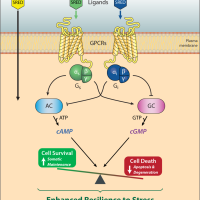
In a University of California, Irvine-led study, researchers have discovered small-molecule drugs with potential clinical utility in the treatment of age-related macular degeneration (AMD), diabetic retinopathy (DR), and retinitis pigmentosa (RP).
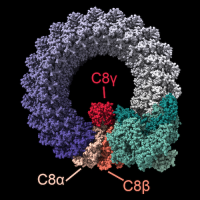
A study from the National Eye Institute (NEI) identified rare genetic variants that could point to one of the general mechanisms driving age-related macular degeneration (AMD), a common cause of vision loss in older adults.
Texas Congressman Pete Sessions visited the NIH March 27 to meet with NEI Director Michael F. Chiang, M.D., and to tour NEI’s Section on Ocular and Stem Cell Translational Research, led by Kapil Bharti, Ph.D.
Researchers at the University of Alabama at Birmingham discovered that night vision tests at a specific location in the retina will be suitable for assessing treatments and preventions for AMD.
Researchers supported by the NEI are developing artificial intelligence/machine learning (AI/ML)-based systems that not only screen for AMD but also predict which patients will likely progress to late within two years.
UVA Health scientists have discovered an unknown contributor to harmful blood vessel growth in the eye that could lead to new treatments for blinding macular degeneration and other common causes of vision loss.
A pilot study of 106 patients with “wet” AMD revealed that nearly half of patients treated with Eylea could safely stop therapy after one year, compared to only 17% of patients treated with Avastin.